





















Elon Musk's SpaceX catches giant Starship rocket as it returns to Earth in major breakthrough
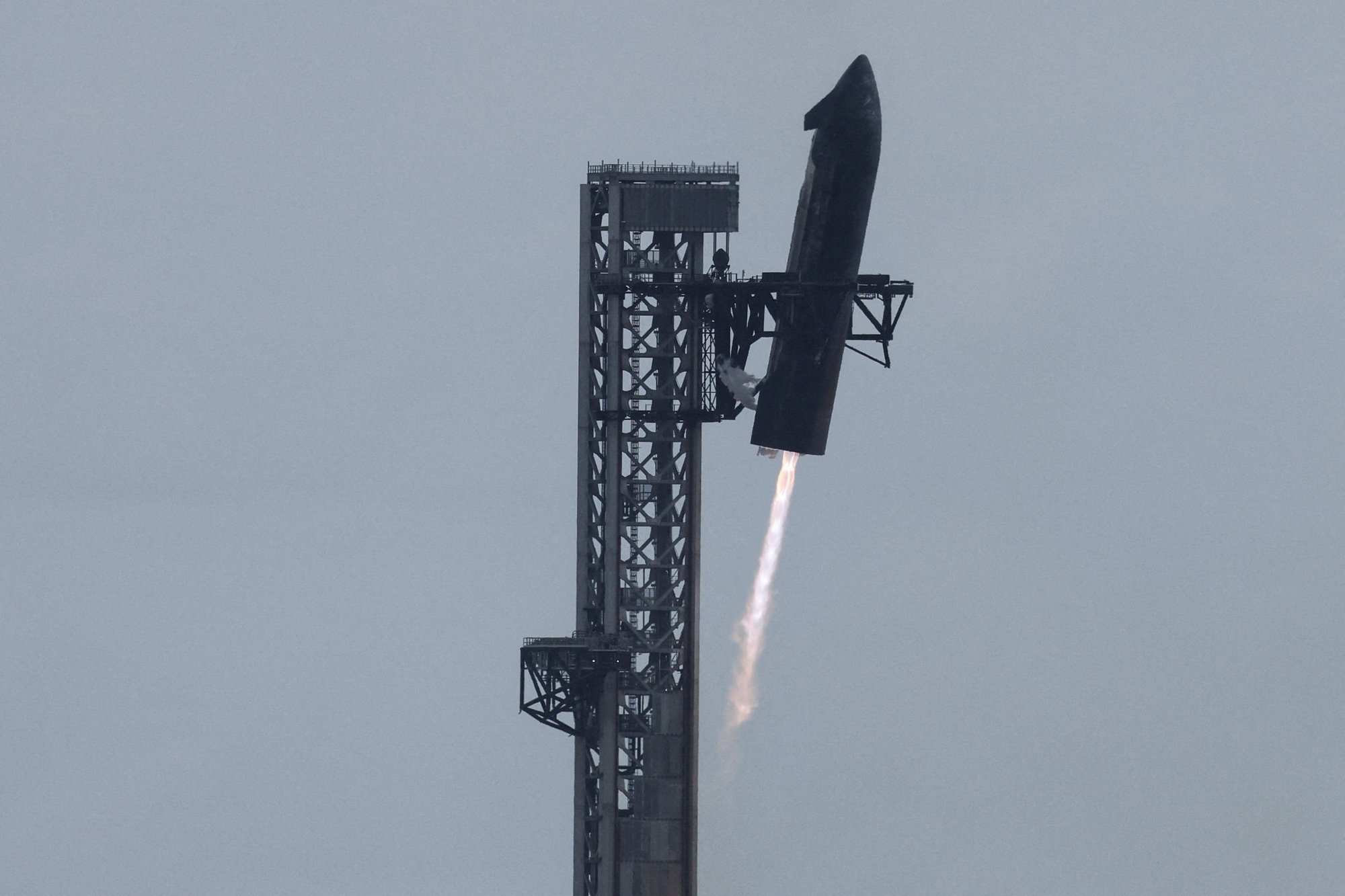
SpaceX has marked a historic achievement after recovering its Starship spacecraft in midair for the first time.
The manoeuvre saw the bullet-shaped vessel snatched out of the sky with giant mechanical arms at its Starbase facility in south Texas.
The 52-metre upper stage descended through cloud cover yesterday after enduring the punishing heat of atmospheric re-entry.
It then slowed itself with engine burns before slipping between the tower's so-called "chopstick arms" above Launch Pad 2.
The capture concluded a mission lasting roughly 22 and a half hours, during which the stainless steel craft completed 14 orbits of Earth, only its second journey into orbit.
Yesterday's feat represented the 15th test flight of the world's largest and most powerful rocket system, a programme that has been running since 2023.
Onlookers gathered on nearby Gulf of Mexico beaches erupted in celebration as the spacecraft settled into position.
During its orbital journey, the spacecraft released 26 third-generation Starlink satellites to bolster Elon Musk's space-based internet network.


Some of those satellites were also used to photograph the craft's heat shield, allowing engineers to assess its condition before re-entry.
SpaceX spokesman Dan Huot said: "That was the Holy Grail of space flight, plummeting through fire to be snatched out of the air by steel. We caught a Starship, and now, everything changes."
Recovering the upper stage posed far greater technical challenges than previous booster catches, as the spacecraft was travelling at much higher speeds and falling from a much greater altitude.
SpaceX had successfully captured returning boosters on three prior occasions, but never the orbital vehicle itself.
LATEST DEVELOPMENTS
- Nasa spacecraft just days away from reaching historic milestone: 'Astonishing!'
- BT pauses 'giant leap' for rural UK broadband until 'noise has died down' over Elon Musk's Starlink
- British scientists make 'thrilling' one-in-10-billion discovery after 40 years of searching

Clayton Swope, an aerospace analyst at the Centre for Strategic and International Studies, described the mission as a "huge technical achievement" that "proves the whole idea of Starship as a fully reusable spaceship can work".
The mission had been conceived as a historic double-catch, with both stages of the 124-metre rocket returning intact to the launch site.
Those ambitions were scuppered on Friday when the Super Heavy booster encountered a guidance anomaly minutes after lift-off.
Kate Tice of SpaceX explained that the booster's navigation system detected it was not in the correct position to proceed with a catch, automatically diverting it away from land toward the Gulf of Mexico.

Mr Huot confirmed: "It was doing what it was supposed to do. Basically, it detected that the booster was not in the place it was supposed to be to proceed with a catch."
Elon Musk said on social media that the booster had also been "slightly low on fuel".
The first stage self-destructed in a fireball before reaching the water, with buoys cordoning off the debris as engineers began investigating why its engines cut out prematurely.
The successful spacecraft recovery marks a crucial step towards making launch vehicles entirely reusable, a goal that has eluded the industry for decades.

Mr Musk has said he wants to accelerate the test flight tempo to weekly and eventually twice-weekly launches.
The company also plans to begin flying Starships from Kennedy Space Centre in Florida within the coming months.
Nasa Administrator Jared Isaacman, an ally of Musk who was recommended for the role by the SpaceX founder, praised yesterday's achievement.
He wrote on X: "It was almost magic… Making more believers by the day… one step closer to [the Moon]."
Our Standards: The GB News Editorial Charter
What's Your Reaction?
 Like
0
 Dislike
0
 Love
0
 Funny
0
 Angry
0
 Sad
0
 Wow
0